
DividendeOhneEnde · December 15, 2019
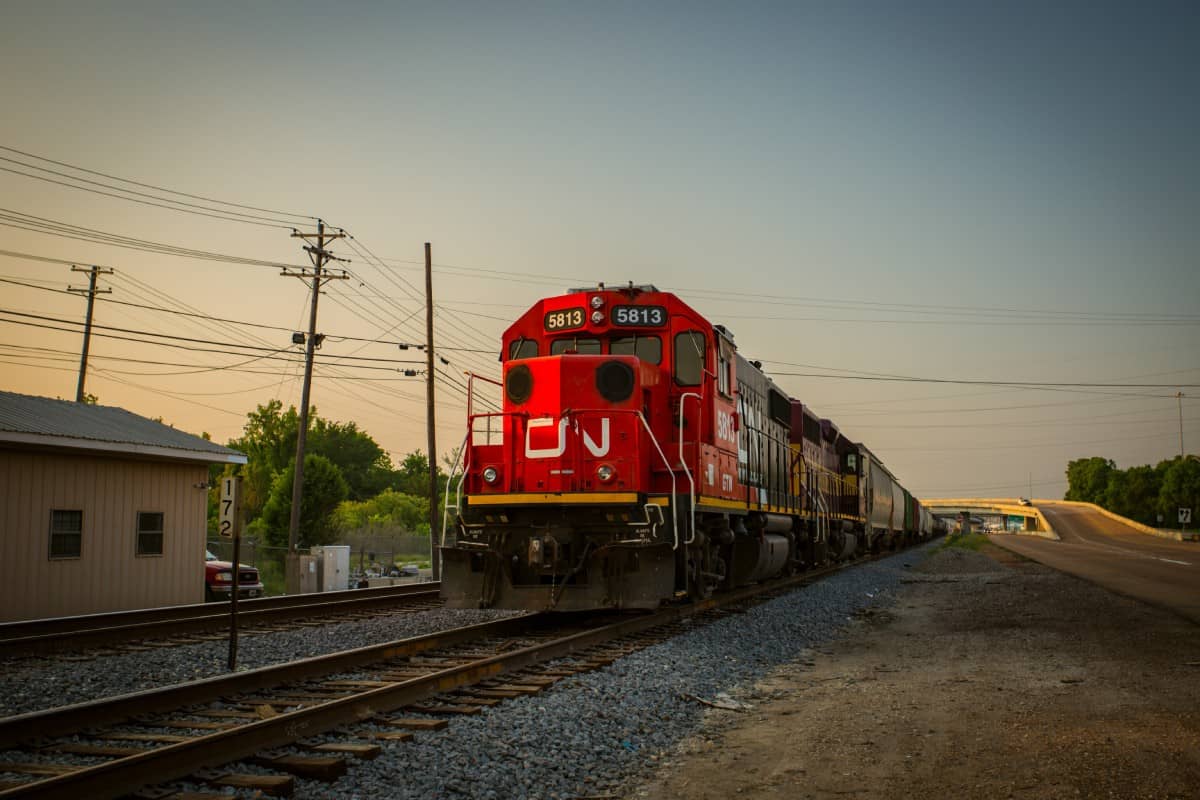
Canadian National Railway
Next Stop: All-Time High
- Ticker
- CNI
- ISIN
- CA1363751027
- WKN
- 897879
- Country
- Canada
- Industry
- Industrials
- Sector
- Freight & logistics
- Market cap
- $76.3 billion
- Dividend yield
- 1.90%
- Payouts
- quarterly
- First dividend
- 1995
- Status
- Dividend Achiever
- Dividend yield
- 1.9%
- Dividend growth
- 12.6%
- Payout ratio
- 38.5%
- Share price growth
- 240.7%
- Earnings growth
- 9.2%
- Revenue growth
- 3.8%
- Debt ratio
- 29.7%
The DOE score was my rating at the time, based on these figures, from A (very good) to E. Figures as of October 11, 2022, shortly before the blog ended.
Contents
The 3-coast connector
I know that we Germans don't exactly speak highly of our railway companies. Deutsche Bahn keeps coming under fire and is currently having to work on quite a lot of problems at once. But for an environmentally conscious and modern future, we need a functioning and stable railway. Some of you may already know - I myself have been working at DB in Munich since 2011. From an employee's point of view, I have to say that DB is a top employer, even though I'm not happy with some political developments. Little spoiler: as of February 1, 2020, I'll no longer be at the railway - more on that in a separate article sometime.
Would I buy shares of Deutsche Bahn? Apart from the fact that 100% of the shares belong to the state: "No, never in the current situation!" But why not broaden your horizons and look beyond your own backyard? On the other side of the globe there's the Canadian National Railway (CN). Although its rail network is almost 1,000 km shorter in total than DB's, I'd very likely put its stock in my portfolio. You'll find out why in this article.
The history and business model of Canadian National Railway Company
The first fully rail-bound means of transport were built as early as the beginning of the 17th century. Back then, wooden wagons were used in mines to carry heavy raw materials to the surface and eventually to the river barges. Over the years this system was continually improved and expanded. The real boom, however, only came in the 19th century, when the Industrial Revolution was in full swing. The demand for raw materials rose rapidly and horse-drawn carriages quickly reached their capacity limits. So a new, more powerful means of transport was needed. This is where George Stephenson comes into play. He grew up in a poor family in the north of England and had to work in a coal mine from the age of 14. When his father was blinded in an accident with a steam engine, George took a closer interest in these machines. In 1814 he developed his first steam locomotive; it wasn't the first locomotive ever, but definitely the first one that was industrially usable. Under his direction, the world's first railway line opened in 1825. Shortly afterwards, railway fever spilled over into the rest of the world - reaching Canada in 1836.
In the early days, England remained the driving force of rail transport. With the expertise of English engineers, the first railway companies were formed in the USA and Canada. Among them was the Grand Trunk Railway Company of Canada, founded on November 10, 1852. Initially, a railway line was to be built between Montreal and Toronto, but it was quickly extended in both directions. More lines were continuously built in eastern Canada and the northern USA, so that by 1867, with 2,000 km of track, it operated the largest railway system in the world at the time. When the colonies united that year, it was asked, as the leading Canadian railway company, to build a line to the Pacific coast. However, since it declined, the Canadian government saw itself forced to found the Canadian Pacific Railway and build the line itself. At the beginning of the 20th century, though, GTR also wanted to operate a transcontinental network and thus had to work with the government after all. When the railway company's president Charles M. Hays died on the Titanic's maiden voyage, the management of GTR deteriorated. And the construction costs of the new railway line eventually led to the company's bankruptcy.
The Canadian government founded the Canadian National Railways on December 20, 1918, to prevent Canada's transport links from collapsing due to the bankruptcy of several railway companies. By 1923 it had taken over several railway operations, including the Grand Trunk Railway, and united them under a new state umbrella. Until the 1980s, business went rather poorly. This was mostly because political rather than economic decisions were made within the company. With the recapitalization in 1978, the realignment of Canadian National began. The full IPO followed in 1995. Since then it has mainly been active in the following business areas: Rail (transport business with a 32,000 km network - from the Pacific, to the Atlantic, and to the Gulf of Mexico), Intermodal (container business by rail, road and water), Trucking (truck freight business), Supply Chain Services (logistics services) and Business Development (working with customers on planning and implementing new sites).
How will business go for Canadian National Railway in the future?
I love companies with a strong moat. And Canadian National is definitely one of them. Both in terms of the size of its rail network and the railway company's revenue, it's Canada's number 1. No other railway operates such a long network, stretching from western Canada to the coast in the east and even all the way through America to the Gulf of Mexico. For the life of me, I can't imagine a new company coming along tomorrow and simply building new tracks right next to it. So railway companies have a strong geographic monopoly.
However, a large rail network also means high capital expenditures. In fiscal year 2018 alone, the company put 3.5 billion US dollars into its own infrastructure. But it's not only the tracks that get investment, it's also new locomotives and, of course, trained staff. Currently around 25,000 people work for the railway company - maybe this number will drop in the future, once autonomous driving becomes ready for everyday use at some point.
Economic dependence on the USA is often cited as a risk. If the American economy ever goes down the drain, Canadian National Railway will surely feel it too. But I also think that, conversely, the USA is just as dependent on CN. Who else is supposed to transport all those goods and freight? Especially over long distances, railways are much more efficient than trucks. They're also many times more environmentally friendly. I'm sure the US government is well aware of this point.
Last but not least, I'd like to mention Canadian National Railway's share buyback program. It's currently buying back huge amounts of its own shares, which of course also affects the share price. For us investors that's always a nice thing, because in the long run such a program always pays off. In January 2019 the board approved the repurchase of another 22 million shares. This program is set to run until the end of January 2020. The company wants to stay at a payout ratio of about 35 percent, steadily increase its dividends and return the rest to shareholders in the form of share buybacks.
And what about the dividend?
Since its IPO (initial public offering) in 1995, Canadian National Railway has paid a dividend to its shareholders. On top of that, it has been raised every year since then. So by simple arithmetic, the railway company will join the elite circle of Dividend Aristocrats in 2020. The current dividend yield amounts to 1.8 percent, which corresponds to a payout ratio of about 35 percent. Looking at the dividend growth rate over 10 years, you get an impressive 15.9%, and over 5 years even a 17.5% increase per year.
Conclusion:
Canadian National Railway has a nearly insurmountable moat. Not only I, but also Warren Buffett and Bill Gates are big fans of such companies. No wonder Bill Gates put part of his fortune into the railway company. So if you're looking for a solid stock with stable growth, you're in very good hands here.
Epilogue · November 1, 2026
What became of it
6 years and 10 months have passed since this article. If you had invested €1,000 on the day it was published, this is where you would be today:
Bitcoin came out ahead.
- Canadian National Railway, incl. dividends:
- The same €1,000 in Bitcoin: