DividendeOhneEnde · March 1, 2020
Lowe’s Companies
The stock for DIYers
- Ticker
- LOW
- ISIN
- US5486611073
- WKN
- 859545
- Country
- USA
- Industry
- Consumer discretionary
- Sector
- Specialty retail
- Market cap
- $127.2 billion
- Dividend yield
- 1.90%
- Payouts
- quarterly
- First dividend
- 1961
- Status
- Dividend King
- Dividend yield
- 1.9%
- Dividend growth
- 19%
- Payout ratio
- 29.2%
- Share price growth
- 534%
- Earnings growth
- 26.6%
- Revenue growth
- 7.2%
- Debt ratio
- 71.9%
The DOE score was my rating at the time, based on these figures, from A (very good) to E. Figures as of October 11, 2022, shortly before the blog ended.
Contents
The store for people who roll up their sleeves
Man oh man, what a crazy week that was. The coronavirus caused total panic on the markets. The benchmark Dow Jones lost more than 3,500 points last week - the biggest drop since the 2008 financial crisis. Only the US Federal Reserve managed to contain the panic a bit on Friday afternoon: it said it would step in as needed to cushion the economic fallout of the coronavirus epidemic. Will things calm down now, or will our stocks sink even further? That's probably the question of all questions. And unfortunately I don't have a crystal ball either - BUT: I see my account, and I see my incoming dividends. If I can then buy stocks at a special discount, that's a great opportunity, right?
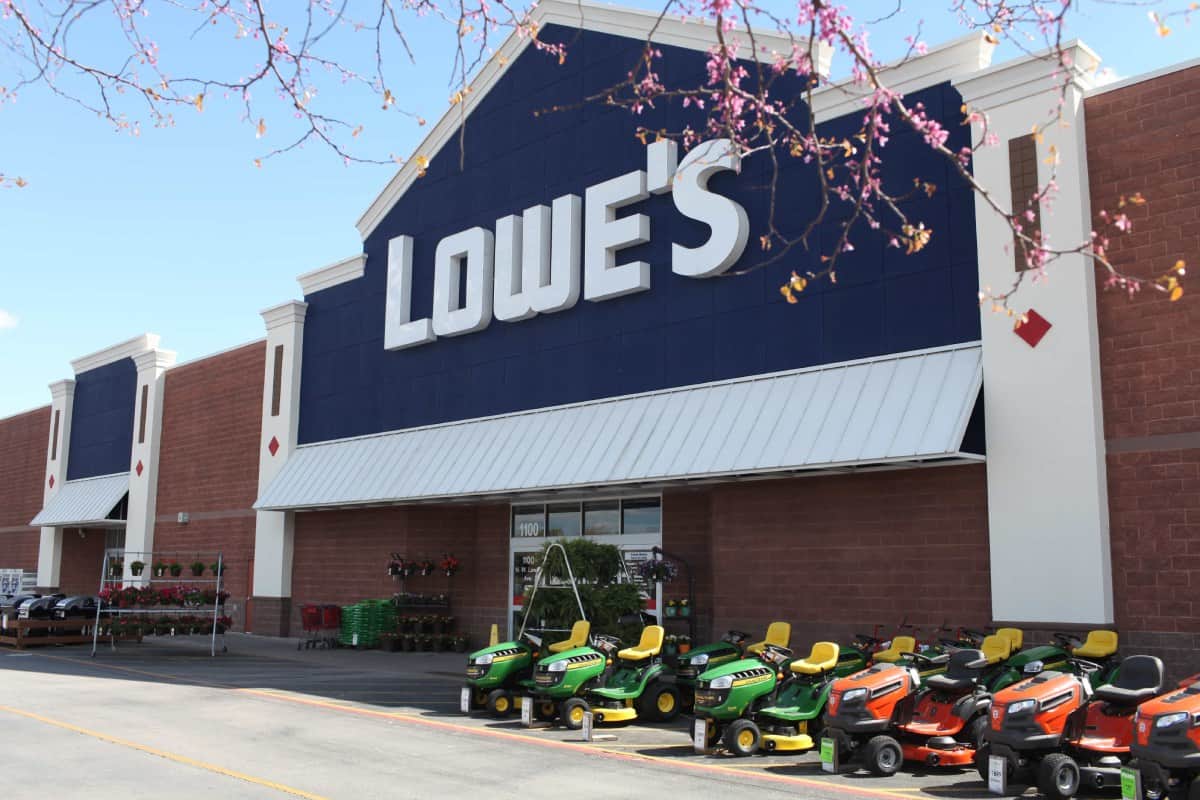
So for that reason, today let's take a look at a very solid, relatively unspectacular, but still fast-growing company that itself regularly advertises special discounts - not for shareholders, though, but for customers. And they love shopping at the second-largest home improvement chain in the world (first place goes to Home Depot).
The history and business model of Lowe’s Companies Inc.
In the following I'd like to go into the success story of Lowe's Companies Inc. Over the years it grew from a small general store into a strong home improvement giant. The company's roots go back to 1921, when Lucius Smith Lowe decided to open a small hardware store in the small town of North Wilkesboro (North Carolina, USA). The store bore the rather uncreative name "Mr. L. S. Lowe's North Wilkesboro Hardware". Even back then he focused on the production and sale of building materials and hardware. When Lucius died in 1940 at the age of 61, his daughter Ruth inherited the business. Since she didn't feel capable of running the company, however, she sold it to her brother Jim Lowe that same year. He teamed up with Ruth's husband Carl Buchan to run the business together. Shortly afterwards, though, both had to serve in the US Army in World War II. So during that time Ruth and her mother ran the hardware store again.
Buchan was wounded in the war in 1943 and subsequently discharged from the army. Back in North Wilkesboro he took over management and quickly realized that he would have to reorganize the store. At the time it was also selling a lot of items that had nothing to do with the actual hardware business. These included sewing supplies, textiles, horse saddles and snuff. Buchan was aware that the demand for building materials would rise rapidly after the war. So in 1946 he acquired a 50 percent stake in the company. Business was booming, and by 1949 they had earned enough to open a second store. By 1952 Buchan became the sole owner of the company. Jim Lowe later founded the grocery chain Lowes Foods. Buchan continuously reinvested the profits into opening more locations, and the snowball gradually started rolling. When he died of a heart attack in 1961 at the age of just 44, the company had 21 stores with impressive annual revenue of $32 million. That same year Lowe's Companies Inc. went public.
In the 1980s another player entered the market that increasingly grew into a serious competitor and made life hard for Lowe's. I'm talking, of course, about the home improvement chain The Home Depot, which introduced a completely new format with huge stores. For a long time Lowe's resisted this new "big-box" format, but in the end it spent a lot of money and converted its existing stores to this model. From then on things were running smoothly again and it was able to keep expanding. Today Lowe's Companies operates more than 2,200 stores in the US and Canada and serves over 18 million customers a week. In addition to the classic retail business, it also earns very good money in the business-to-business sector.
How will Lowe's Companies' business develop in the future?
There's surely no question that the management of the world's second-largest home improvement company will keep trying to expand into new regions. In the US it's getting harder and harder to find lucrative locations. That's why they're not shying away from looking beyond their own backyard. Canada and Mexico are the obvious choices here, of course. Although they recently had to close some stores there. Home Depot, for example, dared to cross the big pond to China - but had to close all 7 stores there again too. Still, you shouldn't give up hope, after all they employ the best experts, who have surely learned from missteps like that.
And the market is still booming. More and more people are starting to repair their stuff again or build new things. The do-it-yourself sector has a lot of fans by now. You can follow that really well on YouTube, for example, where videos of homemade projects rack up millions of views. Home improvement stores naturally benefit from a trend like that. So that it's not just adults who get a taste for it, Lowe's has recently started offering free kids' craft workshops at all its stores nationwide.
Home Depot and Lowe's Companies do target the same customers, but their store layouts differ enormously. Home Depot stores have several tall shelves that can only be accessed with a forklift - which of course creates a certain "pro look." Lowe's Companies, on the other hand, goes for a more pleasant shopping experience, which doesn't put off first-time customers as much as the competition's store concept might. But in the end that's purely a matter of taste. Another point where the two home improvement stores differ is the logistics network. Here Lowe's currently has a lead over Home Depot - it started building a more efficient supply chain much earlier.
And it's exactly this optimized logistics network that will become much more important in the future. More and more customers are switching from offline shopping to convenient online shopping. There are several options here: customers can browse the catalog online, find the product they want and order it online and have it delivered, Amazon-style. Larger items could also be sent to a nearby store where the customer picks them up. Or the customer is in the store because they want their specific questions answered and to talk to a trained expert, but doesn't have a car and wants the purchase delivered to their home. Apart from private customers, construction companies can also order large quantities of building materials from Lowe's Companies and have them delivered directly to the construction site. In all of these and many other cases, a smooth supply chain is needed to ensure the best customer satisfaction.
Fundamentally, you can say that when the US economy is doing well, more properties get built and renovated, and so Lowe's earns very good money in a phase like that too. And as harsh as it sounds, Lowe's and Home Depot also benefit from devastating storm damage. And experts assume that, as climate change progresses, we'll see quite a few more of those.
And what about the dividend?
Here Lowe's Companies is a real model company. Since 1961, i.e. since its IPO, it has been paying out a share of its profits to its shareholders. And since then the dividend has been raised year after year. The average over the last 10 years is an outstanding 19.44 percent per year. The current dividend yield is 2% and the payout ratio is just under 39%. For a Dividend King, those are first-class numbers.
Conclusion:
Lowe's Companies Inc. managed to grow from a small family-run hardware store into one of the global players in the industry. Even though it struggled at times, it constantly proved its adaptability. I'm sure it will be able to put that talent to use with future problems as well. Dividend hunters who don't already have the market leader Home Depot in their portfolio should take a closer look at this company.
Epilogue · November 1, 2026
What became of it
6 years and 8 months have passed since this article. If you had invested €1,000 on the day it was published, this is where you would be today:
Bitcoin came out ahead.
- Lowe’s Companies, incl. dividends:
- The same €1,000 in Bitcoin: