DividendeOhneEnde · June 6, 2021
Bunzl
The packaging distributor
- Ticker
- BNZL.L
- ISIN
- GB00B0744B38
- WKN
- A0ET3E
- Country
- United Kingdom
- Industry
- Industrials
- Sector
- Industrial suppliers
- Market cap
- $10.3 billion
- Dividend yield
- 2.20%
- Payouts
- semi-annually
- First dividend
- 1984
- Status
- Dividend Aristocrat
- Dividend yield
- 2.2%
- Dividend growth
- 6.5%
- Payout ratio
- 42.5%
- Share price growth
- 141.7%
- Earnings growth
- 8.4%
- Revenue growth
- 5.8%
- Debt ratio
- 34.9%
The DOE score was my rating at the time, based on these figures, from A (very good) to E. Figures as of October 11, 2022, shortly before the blog ended.
Contents
From fleeing the Nazis to a global corporation
It's really no secret anymore that, especially as an individual stock investor, you should strive for broad diversification. When it comes to the different industries, I think I'm well positioned - but when it comes to the breakdown by country, I have to own up to it. Definitely too many of my individual stocks come from the USA - most of these companies do operate worldwide and aren't overly dependent on their home country, but I'd still like to be invested more in other nations in the future.
My friend Jörg recently suggested an interesting candidate for this goal: the distribution and wholesale group Bunzl from the United Kingdom. So let's take a closer look at the company today.
The origins and business model of Bunzl Public Limited Company
The origins of today's Bunzl plc go back to 1825, when Moritz Moises Bunzl was born in Prague. A few years later the Bunzls moved to Pressburg, about 300 kilometers away (today called Bratislava - the capital of Slovakia). There Moritz met Minna Biach, 11 years his junior, whom he married in 1854 at the age of 29. To earn money, Moritz founded the firm Emanuel Biach's Eidam that same year. I think this company name needs a short explanation: Emanuel was Minna's father, and Eidam is an old-fashioned German term for a man who marries into a family and thereby shares in the daughter's inheritance. His business was the rag trade ("Hadernhandel" - also an old German term) - collecting textile waste that was resold to the textile and paper industries for processing and recycling. The business developed solidly, and when Moritz died in 1875, his three sons Max, Ludwig and Julius took over the management.
Since they expected better growth opportunities in Austria, they moved the company's headquarters to nearby Vienna. They also changed the name to Bunzl & Biach and began gaining a foothold in the textile and paper industries themselves. Over the following decades, the Bunzl brothers built up several branches in Austria and Hungary. In the late 1920s, they developed what was probably the world's first cigarette filter. More precisely, it was the Hungarian Boris Aivaz who invented the filter made of crepe paper, but he depended on the cooperation of a paper manufacturer. In 1927 the filter went into production and over the next ten years was sold to cigarette manufacturers in 15 countries. When Austria joined Adolf Hitler's Germany in 1938, the Jewish Bunzls moved their company headquarters to Switzerland. They also founded a branch in London. Then, when the Nazi regime forcibly seized control of Bunzl & Biach AG, the Bunzls emigrated.
While part of the family settled in Switzerland and the USA, a large part of the family moved to Great Britain, where they were forced to start over. With a loan of 5,000 pounds, Martin, Hugo and George Bunzl founded Tissue Papers Limited to manufacture paper and various paper products. The beginning was tough, and in the first fiscal year they reported a profit of just 179 pounds. A year later they managed to increase that by more than 100 percent - to a whopping 406 pounds ... Fortunately, after World War II the Bunzls succeeded in regaining control of their Austrian factories. In the following years they focused heavily on producing and selling new cellulose cigarette filters and were very successful with them. But when, in the late 1970s, more and more cigarette manufacturers began making their own filters and demand was declining in general, they looked around for new products. During this time they made quite a few acquisitions and tried their hand at many new business areas - by no means all of them successful. But this is how they found their way into the outsourcing and distribution industry and began specializing in disposable food packaging. Bit by bit they got rid of all unprofitable and non-core business units. Today Bunzl plc is active in over 33 countries and distributes both its own products and products from other manufacturers, mainly to business customers.
How might Bunzl plc develop in the future?
Before I turn to this question, I'd like to briefly summarize the wholesaler's business model once more. It's an internationally operating company focused on packaging and consumables. The company itself divides its product range into seven segments:
- Grocery: (26 percent of revenue) food packaging, films, labels, as well as cleaning and hygiene products for supermarkets and grocery stores
- Foodservice: (25 percent of revenue) disposable tableware, catering equipment, food packaging, restaurant supplies, as well as cleaning and hygiene products for hotels, restaurants and food processors
- Safety: (14 percent of revenue) personal protective and safety equipment, gloves, boots, hard hats, hearing and eye protection for industry and the construction sector
- Cleaning & Hygiene: (13 percent of revenue) cleaning and hygiene materials, chemicals and hygiene paper for cleaning and facility management companies
- Retail: (10 percent of revenue) packaging, cleaning and hygiene products for all kinds of retail companies and e-commerce sales channels
- Healthcare: (10 percent of revenue) consumables for the healthcare sector, gloves, masks, swabs, gowns, bandages as well as cleaning and hygiene products for hospitals and nursing homes
- Other: (2 percent of revenue) a variety of product lines for other end-consumer markets
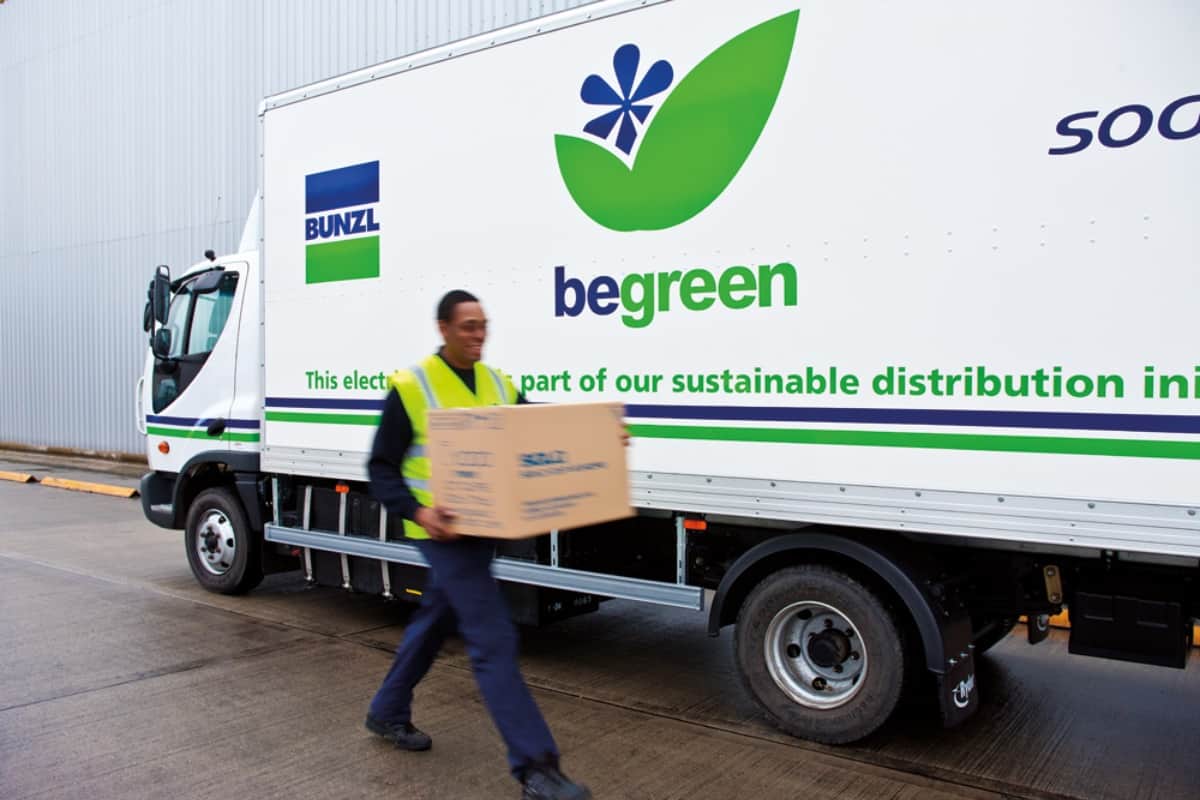
Basically, you can say that Bunzl wants to take work off its customers' hands so they can focus on their core businesses. So Bunzl takes care of purchasing and logistics for the products that are essential to running their businesses successfully. Products come both from its own production and from top international brands like Kimberly-Clark, 3M Company or Ecolab, or from local suppliers. Always with the goal of being able to offer the customer the optimal, tailor-made solution.
Now let's take a look at the most recently published figures from Bunzl plc. In fiscal year 2020 it generated revenue of £10.1 billion, an increase of 9.4 percent over fiscal year 2019. At £618.5 million, profit in this period was even a proud 17.1 percent higher than in the prior-year period. Adjusted earnings per share are definitely impressive too: 164.9 pence per share, or an increase of 26.6 percent.
To stay on its growth path in the future, Bunzl invests heavily in its own growth and doesn't shy away from buying suitable companies either. Since 2004 it has made a whopping 172 business acquisitions. Even though this number seems very high at first, I'm still sure that it learned from its past and now only buys companies that strengthen its own core business. For example, just a few days ago it announced that it would acquire the New Zealand distribution company Obex Medical Holdings.
What about the dividend?
Investors in Bunzl plc first got a share of the company's profits in the form of dividends in 1984. Since then the dividend has been paid out year after year, but in the beginning it wasn't always raised. Only since 1992 has the company established a more shareholder-friendly dividend policy with annual increases. That means Bunzl has also been able to count itself among the coveted Dividend Aristocrats for a few years now. Over the last 10 years, the dividend growth rate comes to a solid 7.6 percent. At about 2.4 percent, the current dividend yield is definitely impressive too, and that's even though the payout ratio of around 42.2 percent also still leaves room for future increases. One trend I don't particularly like, on the other hand, is that Bunzl has been issuing new shares almost every year since 2008.
Conclusion:
Today's distribution and wholesale group Bunzl has an eventful past behind it, in which it has proven several times that it's adaptable and can handle major crises. In my opinion, chances are good that Bunzl's business can continue to develop well over the next few years.
Epilogue · November 1, 2026
What became of it
5 years and 4 months have passed since this article. If you had invested €1,000 on the day it was published, this is where you would be today:
Bitcoin came out ahead.
- Bunzl, incl. dividends:
- The same €1,000 in Bitcoin: