DividendeOhneEnde · January 31, 2021
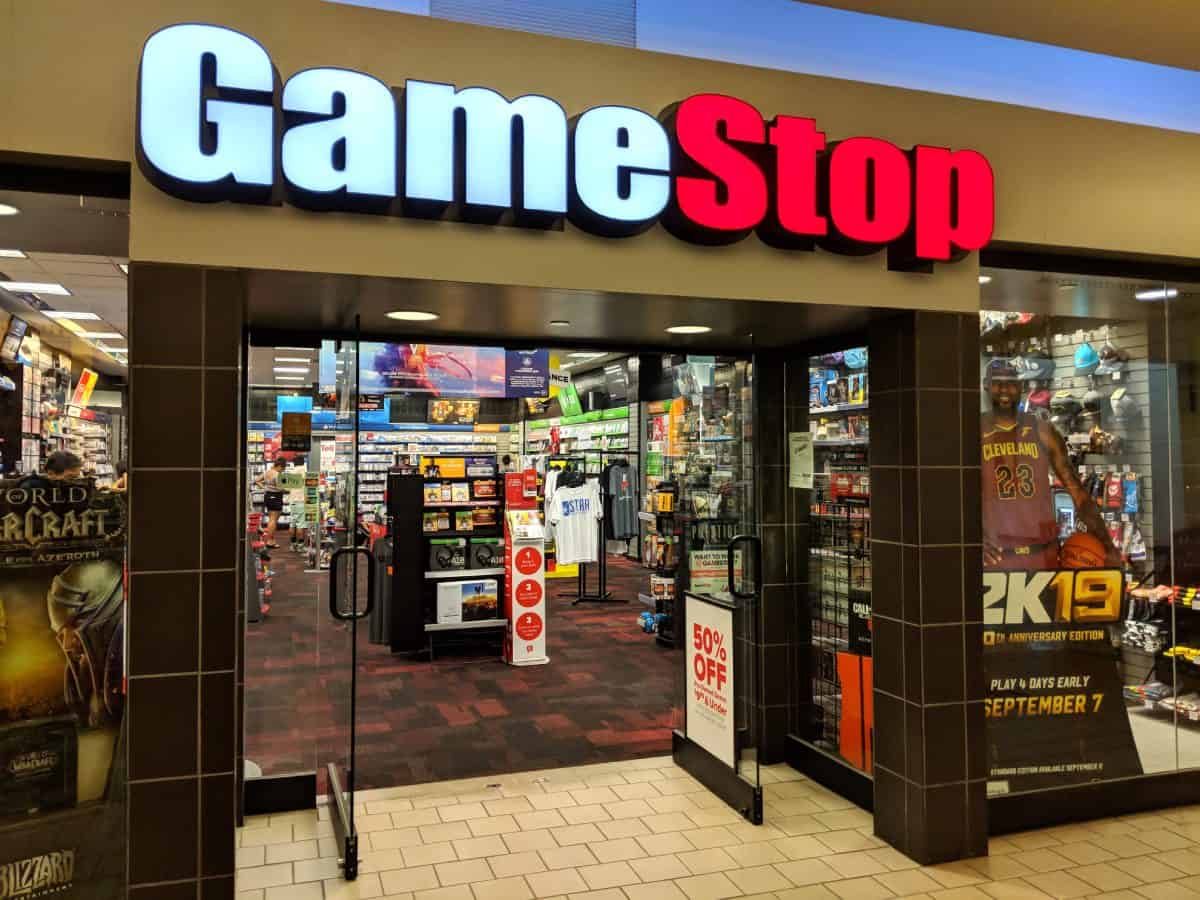
GameStop
An insane stroke of genius?
- Ticker
- GME
- ISIN
- US36467W1099
- WKN
- A0HGDX
- Country
- USA
- Industry
- Consumer discretionary
- Sector
- Media
- Market cap
- $1.9 billion
- First dividend
- 2013
- Status
- No dividend
- Dividend yield
- 0%
- Dividend growth
- 0%
- Payout ratio
- 0%
- Share price growth
- 325%
- Earnings growth
- -35.3%
- Revenue growth
- -6.2%
- Debt ratio
- 21.5%
The DOE score was my rating at the time, based on these figures, from A (very good) to E. Figures as of October 11, 2022, shortly before the blog ended.
Contents
What an exciting time!!
It's been just one month since I wrote my annual review of the absolutely thrilling stock market year 2020 - I did not see it coming that things would continue this excitingly right away in January. In a way, there's currently a "war" going on between hedge funds and retail investors. Do you have to take part? NO, absolutely not. To me, GameStop is by no means a future-proof investment - it's more of a red-hot gambling stock. Still, GameStop shares managed to gain an incredible 1,625 percent this month alone. With my article, I want to shed some light on all this: on the one hand, I want to introduce the company itself, and on the other, I want to try to explain the stock's current rocket launch a bit. Only once you see the idea behind this surge do you realize what an insane stroke of genius it is. However, the whole thing also carries tremendous dangers for the overall market, but more on that later.
Don't worry, I still have tons of high-growth, solid and boring stocks in my bag that I want to introduce here one by one. But today I just have to report on this crazy exceptional phenomenon.
The history and business model of GameStop Corp.
Today's GameStop Corporation grew out of the evolution of various retail companies, with Babbage's Inc. considered the video game company's most important predecessor. Its roots go back to James B. McCurry and Gary M. Kusin, two classmates at Harvard Business School who were already thinking about building something together in the mid-1970s. However, after graduating, the two went their separate ways: James worked as a management consultant for Bain & Company in San Francisco, while Gary started working as a General Merchandise Manager at Federated Department Stores Inc. (the predecessor of Macy's) in Dallas. It wasn't until 1982 that James approached his old classmate and told him about his idea of starting a chain of software stores. He recognized the huge potential of the budding computer and video game industry, and Gary hadn't missed the growing demand for home software in his department stores either. Without further ado, the two decided to quit their jobs and went looking for a suitable investor.
Contrary to their expectations, most venture capitalists showed little interest in the business idea, but fortunately, in February 1983, they met businessman and friend of Gary's family Ross Perot, who offered them 3 million dollars for a third of the company. He also advised the two founders not to open 20 stores right away, but to focus on one location first and get it running properly. James and Gary took this advice and, on Memorial Day 1983, opened their first Babbage's store in a Dallas shopping mall. The store was named after the English mathematician Charles Babbage, who invented the first precursor of modern computers with his mechanical calculating machine back in 1822. Just two months after opening, they hit their sales forecast and were able to hire their first full-time employee. Business kept getting better, and by the end of the following year Babbage's was able to open four more stores in the Dallas area. At the time, the focus was entirely on selling popular games for the then-dominant video game system, the Atari 2600.
By 1987, another 35 locations had been added, and they started selling video games for the new Nintendo systems. In that fiscal year, Babbage's had sales of 29 million dollars and made a profit of 1.16 million dollars from that. The outlook was brilliant, which is why they also decided to take the company public in 1988. In my birth year, 1994, the Babbage's chain already had over 300 stores and was in very good financial shape. However, video games and software products were becoming more and more popular, which is why strong competitors like Wal-Mart, Best Buy or Target increasingly entered the market. To position itself better, Babbage's decided to merge with the specialty retailer Software Etc.. In 1999, it was finally bought by Barnes & Noble and somewhat later merged with the computer game retailer Funco. This gave rise to GameStop Corp., which has been listed on the stock exchange as an independent company since 2002. Today it has over 5,700 stores in 14 countries and offers a wide selection of used and new game consoles, video games and merchandise.
Is GameStop's business model future-proof?
To put it briefly: the way GameStop has worked for a long time won't work in the future, in my opinion. Games are increasingly bought from online retailers, if at all. Sony's new Playstation 5 is already available as a Digital Edition without a disc drive - games can be bought online conveniently anytime. Of course, GameStop's management has realized this too, which is why they recently brought Ryan Cohen, the former CEO of Chewy (an e-commerce shop for pet supplies), on board. Cohen believes the strong GameStop brand can be used to build the Amazon of video games. Whether this transformation will actually succeed is, of course, written in the stars.
So why the sudden rise in the stock?
Well, in my opinion there are two different reasons for that: First, more and more investors, including "The Big Short" investor Michael Burry, noticed that GameStop was undervalued. Sure, the outlook isn't exactly rosy, but GameStop still has a strong fan base and sales that justified a higher share price. Of course, we're long past the point of a fair valuation, and that's mainly due to the second reason: a short squeeze.
So that everyone understands what a short squeeze is about, I'd like to explain it briefly. Let's start really simple - you can buy stocks, and you can also sell stocks even though you don't own them. That's called shorting, or short selling. If you buy a stock at $100, for example, it can fall to $0 at most, which limits the maximum risk to that $100. With short selling, we borrow a share (without the lender knowing) and sell it on at the same time. If the share price falls, the difference is our profit. If, on the other hand, the share price rises, at some point we have to close the position to limit our losses. In the same example, we short the stock at $100. If it falls to $10, we've made a $90 profit - but the maximum risk to the upside is unlimited, since a stock can theoretically rise infinitely.
In GameStop's case, hedge funds had been at work for years, massively short selling the stock, which is understandable given the weak outlook. However, the hedge fund managers took it to the absolute extreme by shorting more than 140 percent of all outstanding shares. Some investors eventually found this out, shared it on the Wallstreetbets subreddit and decided to buy the stock. If prices rise, the hedge funds eventually have to close their positions, i.e. buy back, which drives the stock price up even further. That's when a snowball effect sets in, the so-called short squeeze.
Where do I see the danger?
Maybe two things up front: I think it's important that we have a free market - everyone is allowed to buy and sell whatever and as much as they want. But being able to short more than 100 percent of a stock is wrong, in my opinion! Likewise, I think it's wrong and absolutely ridiculous that Reddit users are portrayed as wild gamblers. I think people have simply discovered a flaw in the financial system and are now showing the greedy hedge funds that they can't get away with everything anymore. But what are the hedge funds doing now? They're raising money to delay the moment they actually have to close their positions for as long as possible. Meanwhile, it feels like they're doing everything they can to bring the share price down again. They run paid ads claiming they've already closed their positions and that retail investors should now sell their shares again. But they also have to close their other stock positions and sell investments that are doing well, which the overall market definitely felt last week. On Thursday, it was actually no longer possible to buy GameStop shares at most brokers, you could only sell. I think everyone can imagine that the already angry retail investors didn't like that one bit.
To sum it up: the GameStop short squeeze has by now become much more than just some boring event on the stock market. It's an emotionally charged "war" between the Diamond Hands (the name for Reddit users who will under no circumstances sell their shares) and the hedge fund managers, who are increasingly getting into trouble. Nobody can really say how it will all end - fact is, we're in for an extremely exciting week on the stock market.
Does GameStop currently pay a dividend?
From 2013 to 2019, GameStop paid a dividend to its shareholders. Even though, as an investor, I really do like dividends, I have to say that scrapping the dividend was a good decision. The money is better used to set the company up sensibly for the future.
Conclusion:
I strongly advise long-term investors against buying GameStop shares at this point - we're currently in an absolute state of exception. There's also no question that the stock will fall again sooner or later. Still, I'll keep following this spectacle closely, after all, you don't experience something like this every day. I'm also very curious to see what further effects it has on the broader market and who will ultimately win the fight.
Epilogue · November 1, 2026
What became of it
5 years and 9 months have passed since this article. If you had invested €1,000 on the day it was published, this is where you would be today:
Bitcoin came out ahead.
- GameStop, incl. dividends:
- The same €1,000 in Bitcoin: