DividendeOhneEnde · January 9, 2022
Kellogg Company
The inventor of corn flakes
- Ticker
- K
- ISIN
- US4878361082
- WKN
- 853265
- Country
- USA
- Industry
- Consumer staples
- Sector
- Food & tobacco
- Market cap
- $25.2 billion
- Dividend yield
- 3.20%
- Payouts
- quarterly
- First dividend
- 1925
- Status
- Dividend Achiever
- Dividend yield
- 3.2%
- Dividend growth
- 2.1%
- Payout ratio
- 53.7%
- Share price growth
- 39.8%
- Earnings growth
- 4%
- Revenue growth
- 2.7%
- Debt ratio
- 32.2%
The DOE score was my rating at the time, based on these figures, from A (very good) to E. Figures as of October 11, 2022, shortly before the blog ended.
Contents
Billions in revenue from corn flakes and other cereals
Even if it's a bit late, I'd like to wish you all a healthy and successful new year 2022. Since the start of the year, the markets have come under considerable pressure again. It almost seems as if the stock market was just looking for a reason to let off some steam again. If you're a long-term investor, though, you shouldn't let such "turbulence" throw you off. If you bet on companies with a solid business model and promising future prospects, you really can't go far wrong. I'm also always a big fan of investing in companies whose products you regularly consume yourself in everyday life.
So today I'd like to take a closer look at the food company Kellogg Company. The company, known for its corn flakes, only recently made some negative headlines when employees took to the streets over bad working conditions. So what we have here is a somewhat controversial investment with a tempting 3.5 percent dividend yield.
The origins and business model of the Kellogg Company
Back then it was common to serve bacon and eggs or the reheated leftovers from the day before for breakfast. But since the patients at the sanitarium could be offered almost nothing but bland porridges and breads made from nuts and grains, Dr. Kellogg soon set out to find a more varied and tastier alternative. He often experimented in his kitchen, where in 1877, for example, he created a twice-baked biscuit made of flour, oats and cornmeal. When a patient broke a tooth on this biscuit, he served it broken into pieces from then on. Toward the end of 1879, Dr. Kellogg‘s brother Will Keith, eight years his junior, also came to the sanitarium to support him in his work. Will quickly became the jack-of-all-trades - he not only looked after the patients, but was also the janitor and bookkeeper at the same time. When the two brothers wanted to bake a more easily digestible bread one evening in 1894, the unexpected happened. They were called away on an urgent matter and dropped everything. The next morning they found the leftover dough from the day before in the bowl, somewhat dried out and swollen. Without thinking much about it, they rolled out the dough, which immediately crumbled. Nevertheless, they decided to bake the crumbs and were all the more amazed when they found tasty, crispy cereal flakes as a result.
The Kellogg's brothers called their new creation Granose and gave it to the patients for breakfast. They loved these novel cereal flakes so much that they even paid to have them shipped home after their stay. John and Will founded the Sanitas Food Company, which, however, sold exclusively to former patients. Their profit margin was fabulous: from a bushel of wheat costing 60 cents they could make enough cereal flakes to take in 12 dollars. Will experimented a bit further and found that flakes made from corn were even crispier, tastier and, above all, kept longer. He smelled big business, wanted to add sugar and sell his corn flakes everywhere, but his brother forbade it. The delicious breakfast snack quickly made the rounds, and within a few years there were dozens of breakfast cereal producers in the city. In 1906 Will took the initiative, split from his brother and founded the Battle Creek Toasted Cornflake Company. Now he added malt, sugar and salt to the dough and began mass-producing his Kellogg's Corn Flakes. He immediately put the profits into advertising.
Thanks to the completion of the transcontinental railroad toward the end of the 19th century, an unprecedented opportunity arose in the USA to distribute products nationwide in large quantities. Will's young company grew at a breakneck pace. He kept building new production facilities and laid the foundation for his international expansion as early as 1914 by building his first plant in Canada. It wasn't until 1922, when the legal dispute with his brother was decided in Will's favor, that the company could rename itself The Kellogg Company. Kellogg's continuously launched new breakfast cereals, perfected its marketing strategies and was thus able to build a solid business. It was a bit late to recognize the trend toward healthier eating. Kellogg's is currently in a restructuring phase in order to produce more efficiently, sustainably and healthily. To that end, it's also focusing more on its core brands again. I'm confident that the food company can build on its past successes again in the future.
How might the Kellogg Company develop in the future?
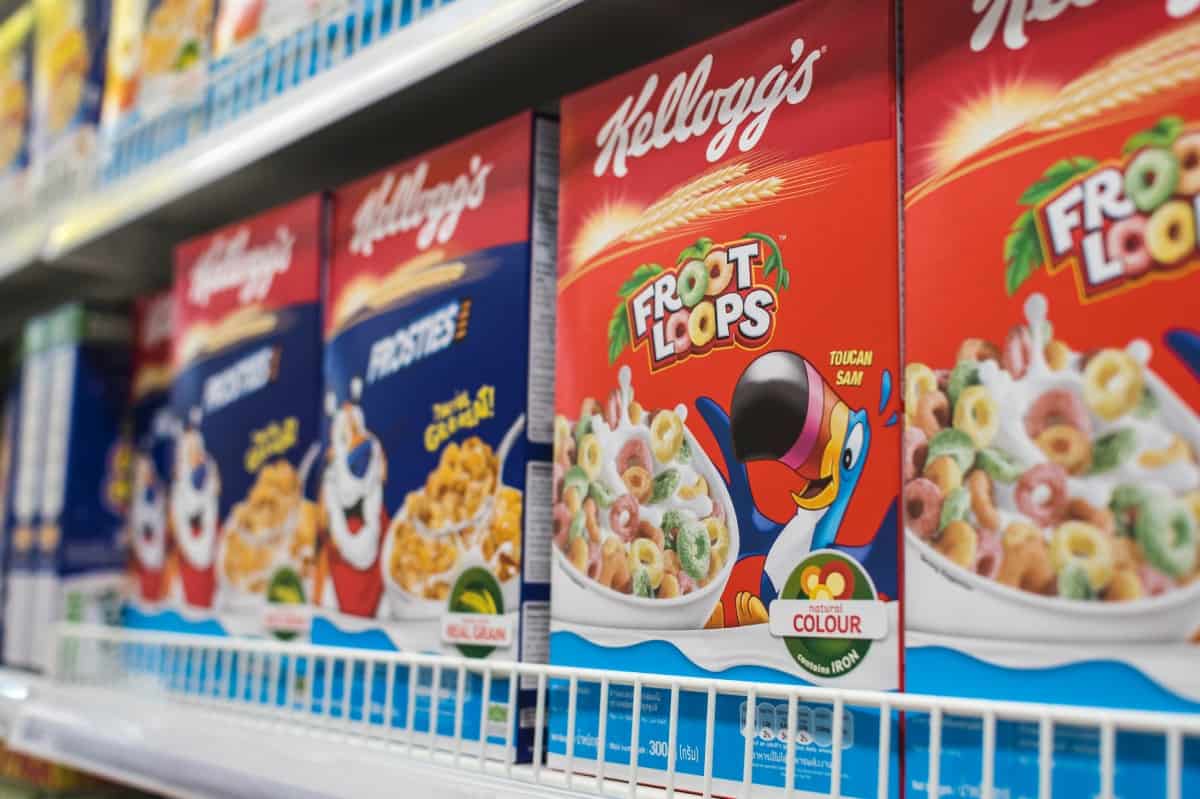
First, I'd like to quickly summarize the business model of the Kellogg Company once more. In addition to its breakfast cereals, the food company also produces snacks such as crackers, chips, toaster pastries and granola bars, as well as ready meals and plant-based meat substitutes. Kellogg's operates production facilities in 21 countries and markets its foods in more than 180 countries. Kellogg's mainly sells to retailers, who in turn sell to the end consumer. Since Kellogg's is an established and valued brand, retailers give the company large and prominent shelf space, which of course it has to share with competitors like Nestlé or General Mills. To name just a few of the top brands from the Kellogg Company: first and foremost the house brand Kellogg's, Cheez-It, Pop-Tarts, Pringles, Bear Naked and Morningstar Farms.
Now let's take a look at the data for the most recently published quarter (Q3 2021 - ended October 2, 2021). At 3.62 billion US dollars, total net sales in this reporting season were about 6 percent above the prior-year result. This growth was mainly driven by positive developments in the emerging regions of Africa, Russia and Brazil. Due to higher expenses, however, net income fell from 352 million US dollars to 305 million US dollars. Accordingly, adjusted earnings per share naturally also fell from USD 1.02 to USD 0.90.
In the long run, I see the food giant's biggest growth opportunities in developing countries. You also have to acknowledge that the company owns numerous top brands that could hardly be better positioned. I think Kellogg's is likely to be a fairly boring investment overall. You certainly shouldn't expect excessive growth here, but I'm optimistic that the stock can get back on track too.
And what about the dividend?
Since 1925, the breakfast cereal company has been sharing its profits with its shareholders in the form of dividends. From then on a dividend was paid every year, but it couldn't always be raised. Most recently, in the years 2001 to 2004, the payout was temporarily frozen. As a Kellogg's shareholder, you also have to be prepared for the dividend to be raised only in small steps. The average dividend growth rate over the last 10 years was just 3.7 percent. On the positive side, though, is the dividend yield - shareholders currently get about 3.5 percent here. In my eyes, the payout ratio of 62.9 percent could certainly be a bit lower; after all, the company still has to invest a good deal to pick up speed again.
Conclusion:
There's no doubt that the Kellogg Company owns a broad portfolio of established brands. Yes, I'm also confident that it can serve its growing customer base in the future and generate good profits doing so. Investors looking for a higher dividend might want to take another closer look at Kellogg's. For my part, though, I won't be buying here for now - the dividend growth rate is too low for me, and I simply lack any vision of the future for this investment.
Epilogue · November 1, 2026
What became of it
4 years and 9 months have passed since this article. If you had invested €1,000 on the day it was published, this is where you would be today:
Bitcoin came out ahead.
Kellogg has been called Kellanova since 2023 and was taken over by Mars in December 2025. From then on, the chart continues with the cash price of $83.50 per share. WK Kellogg, spun off in 2023, is included until Ferrero bought it for $23 per share in September 2025.
- Kellogg Company, incl. dividends:
- The same €1,000 in Bitcoin: