DividendeOhneEnde · July 26, 2020
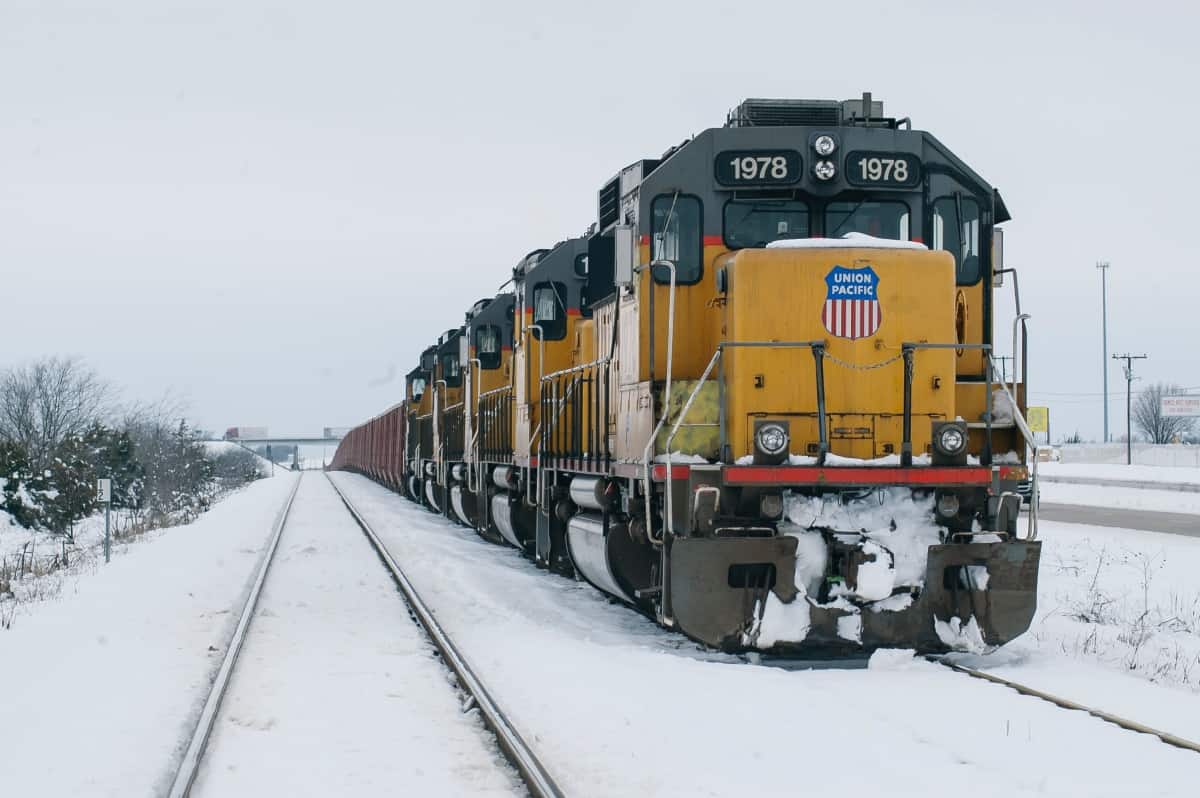
Union Pacific
Hauling freight across the country
- Ticker
- UNP
- ISIN
- US9078181081
- WKN
- 858144
- Country
- USA
- Industry
- Industrials
- Sector
- Freight & logistics
- Market cap
- $123.5 billion
- Dividend yield
- 2.60%
- Payouts
- quarterly
- First dividend
- 1900
- Status
- Dividend Achiever
- Dividend yield
- 2.6%
- Dividend growth
- 16.7%
- Payout ratio
- 46.2%
- Share price growth
- 219.4%
- Earnings growth
- 14.6%
- Revenue growth
- 2.2%
- Debt ratio
- 29.1%
The DOE score was my rating at the time, based on these figures, from A (very good) to E. Figures as of October 11, 2022, shortly before the blog ended.
Contents
The high-margin railroad
I'm constantly in contact with lots of investors - both at work and in various social networks. One topic keeps standing out to me. Most investors want to put their money into trending themes. Sometimes it's cannabis, sometimes hydrogen, and sometimes autonomous transportation providers. The only problem is that at the start of a trend, there are usually lots of new companies jumping on the topic. How is an investor supposed to know which of these companies will really prevail? That's pure gambling.
Some people may label me boring, but I'd rather invest my money in market leaders. In companies that have held their own in the market for years and are highly profitable doing it. Today's candidate fits exactly into that hunting pattern: the Union Pacific Corporation.
The history and business model of Union Pacific Corp.
I already went into the origins of the railroad in general in my article on Canadian National Railway. If you like, you can read the first paragraph of the history section there.
In the beginning, America too had to handle transportation via roads and waterways. So toward the end of the 18th century, a number of artificial canals were built on which cargo ships could transport large quantities of goods. That's how the Erie Canal came to be built, meant to connect New York City with the Great Lakes. That worked very well, but unfortunately, due to geography, canals couldn't be built everywhere. Large mountain ranges, for example, blocked the waterway. So the English railroad came along at just the right time. As in all of Europe at the time, it was especially the English who stood out with their many years of railroad experience. Little by little, a total of 114 locomotives were shipped to the US, where they were put into operation starting August 9, 1829. It didn't take long before the first steam locomotives were built in America too. In 1830 the first two, Tom Thumb and The Best Friend of Charleston, were completed.
But then the Civil War broke out in the US, and track expansion as well as tinkering on new locomotives largely came to a halt. In fact, many stretches of track were destroyed in the war. At this point in history, Abraham Lincoln comes into play, who had just been elected the 16th President of the United States. Lincoln, who had previously worked as a railroad lawyer, was considered a big supporter of rail transportation. So on July 1, 1862, while the war was still going on, he signed the authorization to build the first transcontinental railroad. However, not one but 2 railroad companies were commissioned to lay the tracks: the Central Pacific Railroad, which built eastward from Sacramento, and the Union Pacific Railroad, which worked its way west from Omaha. Not much happened until 1865, though, since during the war there were hardly any financial resources available, let alone construction workers. After the war ended, things could finally get going for real, and both railroad companies were made a great offer. For each section of track laid, they received a flat subsidy and were also allowed to use the land alongside the track. With this offer, the race between the two railroad companies broke out - whoever worked faster and laid more track got paid more. Tracks were laid across the entire country at a truly record pace. As early as May 10, 1869, they met in Utah and celebrated the completion of the first transcontinental railroad with a golden spike. Instead of several months, it now took just under a week to get from New York to California.
The Union Pacific Corporation kept developing, so that today it's still considered one of the railroad market leaders in America. The company largely spun off passenger service in order to focus entirely on freight transportation. And it did so with complete success.
How will Union Pacific Corp.'s business do in the future?
I'm very optimistic about UP's future development. Maybe as a German you can't really relate, but in America people have a completely different relationship with railroads. Just for comparison: Germany has an area of 357,580 km² - America has a total area of 9,831,510 km². You can't just send all goods across the country by truck. In Germany that might still work, but in America it's simply not possible. So you absolutely need a strong rail network.
The railroad also scores over trucks when it comes to the environment. One train replaces between 200 and 300 individual trucks. It's not hard to see that this is significantly more eco-friendly. The same goes for costs - just think of the personnel costs for all those truck drivers. People keep arguing that trucks will drive autonomously in the near future. Yes, that may be. But that will also be significantly more expensive at first before it eventually pays off. On the open road, something like that isn't as easy to implement as it is on rails. Intensive research is currently being done there too on driving trains autonomously. I rate the chances of success much higher here.
Now let's take a look at the different sectors in which the Union Pacific Corporation generates its revenue. The biggest weight here is the "Premium" segment at 31%. That covers the transport of automobiles and also intermodal traffic. Close behind is the Industrial sector, which contributes 29% of revenue. Here UP supplies industry with all kinds of components. Agricultural Products, i.e. farm products like grain or fertilizer, account for 22%, and the remaining 18% comes from Energy, with oil, gas, and mainly coal. Union Pacific has managed to achieve a more than good gross margin of 45 percent. But it's also a fact that the company is heavily dependent on the American economy. If the economy weakens, Union Pacific will feel it quickly too.
Generally speaking, UP has a very strong moat. No new market player is going to come along and quickly build a 51,800-kilometer rail network. Still, Union Pacific isn't a monopoly. After all, there's also BNSF Railway, which also has an extensive rail network. By the way, we can now only invest in that railroad indirectly, since Warren Buffett's Berkshire Hathaway bought it outright in 2010.
What about the dividend?
Union Pacific Railway shareholders received their first profit distribution as early as 1900. Since the business is quite sensitive to the economic cycle, the company hasn't always managed to keep raising the dividend. Most recently, the dividend was held flat from 2004 to 2006. Since then, though, it has been raised every year, and at an impressive pace. Over 10 years, the average growth rate is 20.5 percent. The dividend yield is currently 2.2 percent, and the payout ratio a solid 48 percent. For a railroad company, that's perfectly fine.
Conclusion:
The Union Pacific Corporation has developed wonderfully in the past. I'm just as optimistic about the future, since it serves solvent, high-margin sectors. Furthermore, a strong railroad company is urgently needed in the US. Union Pacific is a textbook boring investment.
Epilogue · November 1, 2026
What became of it
6 years and 3 months have passed since this article. If you had invested €1,000 on the day it was published, this is where you would be today:
Bitcoin came out ahead.
- Union Pacific, incl. dividends:
- The same €1,000 in Bitcoin: